

While contemporary seawater is characteristically saline, one might question the geochemical nature—or colloquially, the “taste”—of the primordial oceans upon Earth’s formation between 4.6 and 4.0 billion years ago (Ga). Was it: (1) sweet, (2) bitter, (3) acidic, or (4) tasteless? To elucidate this, it is necessary to reconstruct the paleoenvironment of the nascent Earth to understand the initial chemical composition of its oceans.
Atmosphere and Ocean Formation Driven by Heavy Meteorite Bombardment
It has been established that upon its initial accretion at 4.6 Ga, the Earth was devoid of an atmosphere and oceans. This is evidenced by the fact that the proto-Earth was predominantly composed of enstatite chondrites, which are depleted in volatile components.
Subsequent findings have revealed that a massive influx of meteorites and asteroids (up to 500 km in diameter) impacted both the Earth and the Moon. This period of intense bombardment occurred between 4.37 and 4.0 Ga, with the Earth receiving a significantly higher volume of impacts than the Moon. Rather than an instantaneous event, this was a protracted process spanning approximately 200 million years. The cumulative effect of these repeated collisions facilitated the accretion of volatile components, ultimately generating the Earth’s atmosphere and oceans.
Over this extensive 200-million-year period, an ocean with a depth of 3 to 5 km was formed. The rate of oceanic volumetric expansion is estimated at 10 cm to 1 m per 1,000 years. The atmosphere and oceans matured gradually throughout this epoch, culminating in a volume comparable to the modern ocean at 1 atmospheric pressure (equivalent to an average depth of approximately 3.8 km).
To delineate this physical process more specifically: over the course of 200 million years, the continuous bombardment by carbonaceous chondrites of varying sizes—which contained atmospheric and oceanic precursors—resulted in the mechanical fracturing and pulverization of the Earth’s primordial continental crust. When a giant impact involving a 500-km-diameter body occurred, the primordial crust was instantaneously vaporized into plasma. Such catastrophic impacts generated craters up to 5,000 km in diameter, exposing the underlying mantle. While some gases and particulates were ejected into space, the majority were retained by Earth’s gravity, eventually condensing to form the atmosphere and oceans.
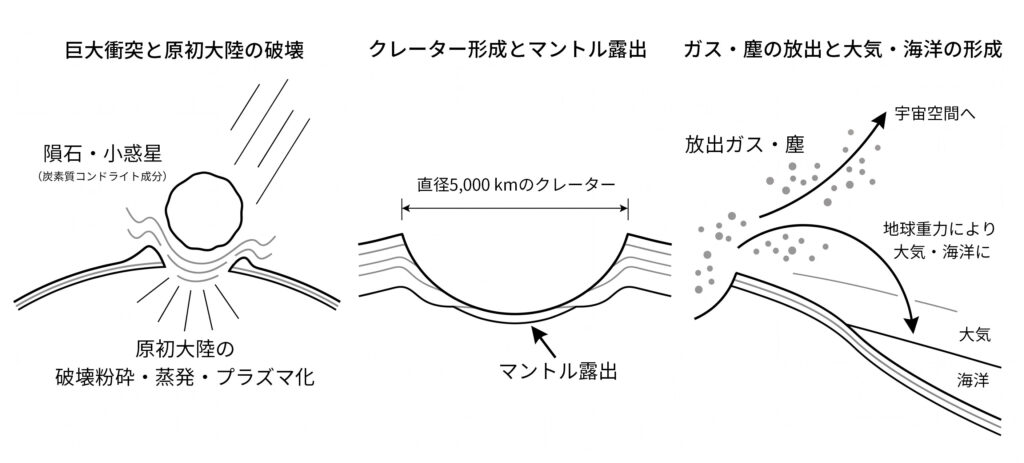
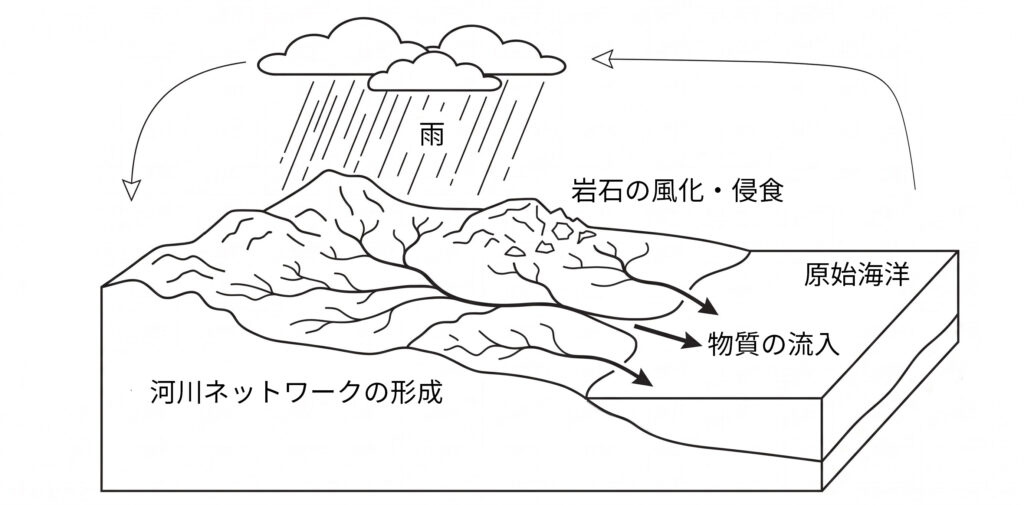
Consequently, localized lakes and primitive oceans began to form on the planetary surface. Solar insolation drove the evaporation of these water bodies, forming clouds. The subsequent precipitation established river networks, which initiated the weathering and erosion of continental rocks, leaching minerals into the aqueous environment. This initiated a macroscopic material cycling pathway spanning from the atmosphere and oceans down to the mantle.
How Earth Avoided a Venus-like State
As massive asteroids and meteorites fractured the surface continents, riverine systems began transporting newly generated inorganic and organic nutrients—essential precursors for abiogenesis—into the primitive oceans.
However, these initial oceans were not analogous to modern marine environments. Water underwent intense chemical reactions with sulfur and halogens embedded within the anhydrous primordial crust. Furthermore, the primordial continental crust formed at 4.567 Ga intermixed with materials derived from carbonaceous chondrites.
As a result, the initial marine geochemical composition was characterized by: (1) a salinity ten times that of modern oceans, comparable to the present-day Dead Sea; and (2) extreme acidity (pH ≈ 1). During this period, the Earth’s surface was enveloped by a 100-km-thick continental crust (comprising KREEP basalts and anorthosite) formed upon the solidification of the magma ocean at 4.567 Ga. Heavy bombardment by giant meteorites fractured this crust, and as precipitation commenced, water reacted chemically with these rocks. This leached essential elements for life (P, O, N, C, H, S, Ca, Fe, Mg) into the ocean as ions. Nevertheless, the extreme acidity and hypersalinity precluded the emergence of life in this marine environment.
However, (3) as the atmosphere and oceans stabilized, surface evaporation facilitated atmospheric moisture transport, initiating global atmospheric circulation. This generated a global climatic system resembling modern conditions, delivering pristine freshwater to terrestrial masses. Furthermore, (4) over the 200-million-year bombardment phase, the atmosphere accreted an estimated total of 400 atmospheres of carbon dioxide (CO2) and 100 atmospheres of nitrogen (N2).
Had these volatile masses been introduced instantaneously, Earth would have inevitably transitioned into a Venus-like state. It is crucial to examine how this trajectory was averted. As previously noted, geological and lunar evidence confirms that the bombardment phase was protracted over 200 million years. This geological record indicates that nearly all of the Earth’s primordial continental crust had been obliterated by 4.0 Ga. The persistent, episodic impacts of giant asteroids severely fractured the crust. The intense heating of the mantle directly beneath these mega-craters induced violent mantle upwelling, which subsequently catalyzed continental rifting and the initiation of plate tectonics.
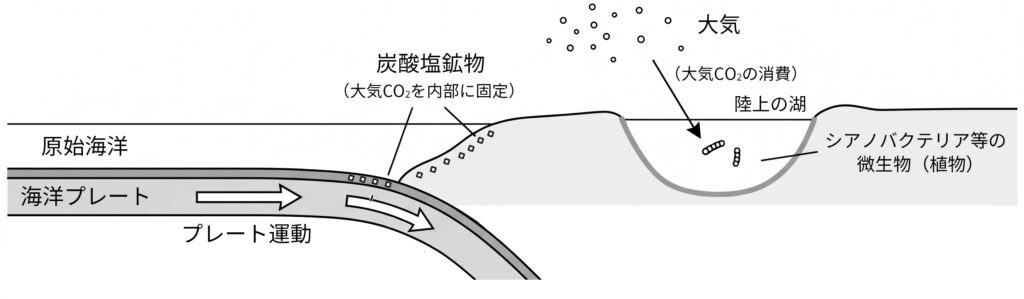
Driven by this tectonic activity, (5) carbonate minerals (which sequestered atmospheric CO2 into solid forms) fixed on the surface of continents and plates were subducted into the mantle. This continuous subduction mitigated the accumulation of atmospheric CO2, maintaining it at a few atmospheres or less, thereby preventing Earth from experiencing a Venusian fate.
Additionally, the emergence of the first biological organisms within terrestrial freshwater lakes was of profound significance. Microorganisms, such as primordial cyanobacteria, functioned as primary consumers of atmospheric CO2.
The Emergence of the Habitable Earth
At this juncture, Earth transitioned into a truly habitable, “living” planet (evidence of terrestrial life establishing itself by 4.0 Ga has been documented by Prof. Tsuyoshi Komiya’s research group at the University of Tokyo). The synergy between the formation of a hydrous planet and the advent of biological life actively prevented a Venusian climate trajectory.
Biological organisms served as a significant carbon sink; upon death, their biomass was entombed within sedimentary deposits, effectively sequestering carbon from the atmosphere. Consequently, atmospheric CO2 levels were perpetually restricted from exceeding a few atmospheres. These sedimentary deposits were ultimately recycled into the mantle via plate tectonics—a pivotal divergence that sealed the disparate fates of Earth and Venus.
(6) Among all planetary bodies in the Solar System, Earth is unique in that it possesses:
- Active plate tectonics,
- Massive continents (which host an overwhelming volume of biomass),
- A global distribution of blue oceans, and
- A biosphere primarily concentrated on its continental masses.
Fundamentally, these four parameters characterize Earth as a habitable planetary system. While this paradigm was initially posited by an Australian research group around 1986, the comprehensive implications—bolstered by novel empirical evidence—were subsequently elucidated by the Whole Earth History research initiative at the Tokyo Institute of Technology (circa 2017). Their research demonstrated that the earliest microorganisms had emerged by 4.0 Ga and that these organisms, inhabiting expansive terrestrial freshwater environments, consumed atmospheric CO2 by fixing it into solid organic compounds (amino acids, proteins, genes, and cell membranes), thereby initiating the macroscopic global carbon cycle.